Tatva-Phite
Tatva-Phite
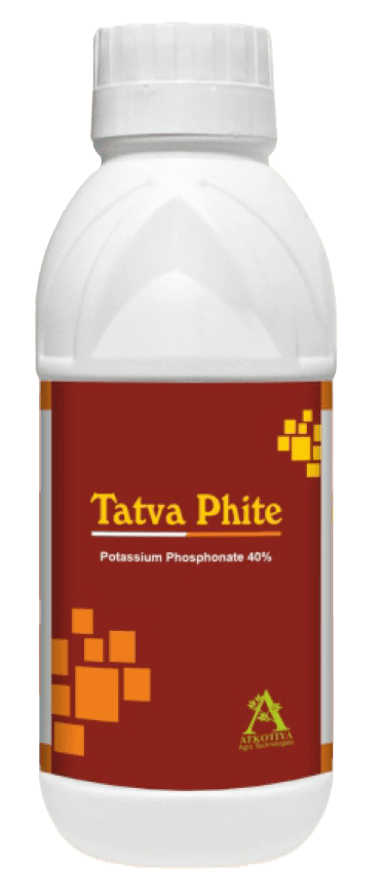
Enhance fruit and grain formation with Tatva-Phite, a Potassium Phosphonate 40% foliar solution. Improves fruit quality, taste, and color while controlling fungal diseases like powdery mildew, downy mildew, Phytophthora, and Pythium. Ensures better crop yield, productivity, and plant health. Ideal for vegetables, fruits, flowers, tea trees, and cotton.
Available Quantity
Composition:
- Potassium Phosphonate 40% (provides Phosphorus (P) and Potassium (K))
Product Overview:
Tatva-Phite is a foliar-applied bio-stimulant and fungicide that delivers essential plant nutrients Phosphorus and Potassium with high purity and low salt index. It ensures immediate nutrient supply during critical growth stages, promotes fruit and grain formation, enhances crop quality, and provides protection against fungal diseases.
Key Benefits:
- Supports fruit and grain formation.
- Improves fruit quality, taste, and color.
- Controls fungal infections like powdery mildew, downy mildew, Phytophthora, and Pythium.
- Enhances crop productivity and reduces alternate bearing.
- Easily assimilable, low salt index, and safe for plants.
- Organic-friendly and eco-safe formulation.
Recommended Crops:
- Vegetables, fruit trees, flowers, tea trees, cotton
Application Guidelines:
- Target Diseases: Powdery mildew, downy mildew, Phytophthora, Pythium
- Timing: Early stage of disease occurrence
- Dilution Rate: 300–350 times
- Application Tips:
- Apply immediately after dilution.
- Compatible with other acidic pesticide/fertilizer formulations; avoid alkaline mixtures.
- Effectiveness may reduce at high temperatures or before rain.
- Best spraying time: after 4:00 pm to avoid strong sunlight.
- Spray widely on top and underside of leaves, stalks, and buds.
- Storage: Store in a cool, dark, dry place; avoid high temperature and direct sunlight.
| Crops | Target Disease | Suitable time for Application | Dilution Rate |
|---|---|---|---|
| Vegetable Fruit Tree Flower Tea Tree Cotton | Powdery & Downy mildew, Phytophthora & pythium | Early stage of insect occurrence | 300-350 times |